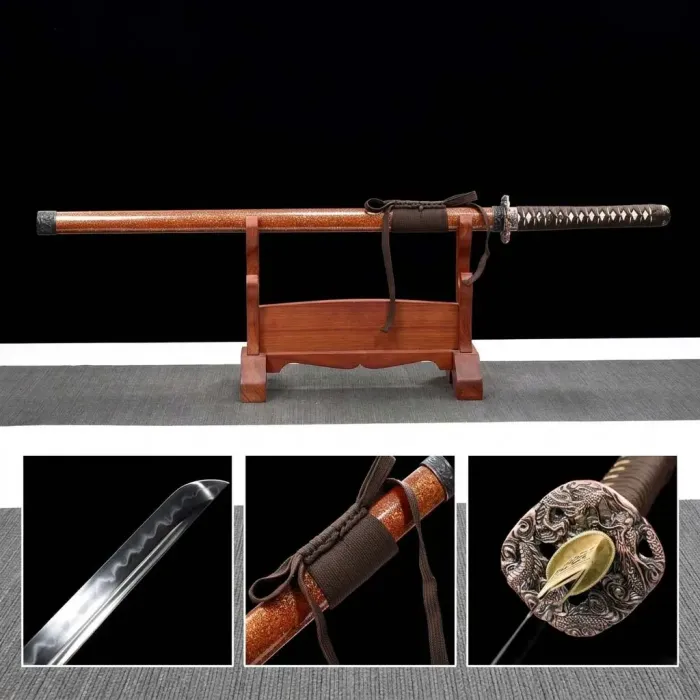
This heritage eastern blade acts as a stunning expression of ingenuity, but consider if you want to convey your distinct manner? Adapting your tool is a rewarding journey, allowing you to build a truly unique piece. From the hold wrapping and band to the covering design and edge design, each segment offers a chance for bespoke design. This exploration delves into the sphere of katana modifications, providing guidance for both rookies and skilled enthusiasts searching to make their signature on the heritage art of the samurai.
Entry-Level Certified Handiwork
For learners determined to embark on the exciting journey of historical swordplay, 1060 steel katanas provide an superior entry point. This specialized grade of structural steel balances a fine equilibrium between price and capability . While not reaching hard as higher-end steels, 1060 permits a suitable level of cutting preparation , making it beneficial for novices to master the rudiments of sharpening care and respect the elegance of handcrafted Japanese weaponry. It’s a excellent choice for establishing experience without the fiscal burden of more elite steels.
T Gear Steel Cutlasses: Balancing Quality and Price
Assisting practitioners seeking an authentic saber experience without crossing the bank , T10 alloy katanas represent a compelling option. These tools offer a noticeable improvement in toughness compared to cheaper alternatives, exhibiting good edge retention and adequate flexibility for basic cutting techniques. While not rivaling the exquisite characteristics of fine steels like T100 or folded compound, T10 provides a admirable blend of effectiveness and reasonableness , making them a trendy choice for initiates and those on a fixed financial .
Past the Blade : Enhancing Your Armament's Components and Grasp
Though the buffed steel is undeniably the central point of a katana, truly enriching its elegance lies in the cautious customization of its ornamentation and hold. This technique allows users to showcase their inimitable design . Reflect on the vast possibilities: menuki - decorative embellishments that provide visual allure ; the hamon casings – often finely engraved ; the tsuka nucleus itself, wrapped in classic ito rope ; and the fusa end piece , which can be designed from various resources like precious metals or shell .
- Pick patterns that relate with you.
- Try with various elements .
- Concentrate on superiority for a lasting influence .
The Enchantment of the Katana: Past, Crafting, and Elements
This traditional armament retains a incomparable allure, steeped in eras of oriental history and legacy . More than merely a weapon of fighting , it's a figure of the bushi ethos – a fusion of ability and discipline . Its advancement spanned plentiful generations, with early swords evolving into the polished curvature and precise edge we acknowledge today. The workmanship involved is truly impressive , requiring years of study to become skilled in . The process involves a multifaceted folding of steel bloom , creating layers that boost the steel’s flexibility and cutting ability. Multiple schools of crafting appeared , each with their separate secrets and methods for achieving the perfect symmetry and definition - a truly heavy pursuit.
- Early Katana shapes
- The purpose of the oriental sword in knight culture
- Conventional processing methods
Deciding the Best Steel for Your Bladed Weapon Project: 1060 vs. T10
Opting for the proper steel is fundamentally important for any armament project, and the judgment between 1060 and T10 can be tough. 1060 is a regular American composition, offering a solid balance of firmness and endurance, supplying it comparatively easy to manage. However, T10, a Far Eastern steel, habitually boasts amplified wear permanence and can probably achieve a superior decisive hardness, although it can be significantly hard to manage and requires exact heat tempering. Consider your skillset and desired goals: for a learner, 1060 may be a more straightforward origin, while the master smith might choose the improved characteristics of T10.
- Facility of Processing
- Surface
- Final Stiffness
Unlocking the Potential: Advanced Katana Customization Techniques
Mastering the art of katana alteration extends far beyond basic finishing. Serious experts are now exploring advanced techniques to truly release a blade's hidden potential. This requires intricate work with the temper line, utilizing specialized compositions for differential strengthening and carefully determining the design of the defense plate to optimize balance and effectiveness. Beyond purely functional enhancements, artisans are increasingly focused on reaching unparalleled aesthetic beauty, through complex decorating and layered polishes that truly transform a katana into a work of art.
Transforming Basic Steel into Art: Building a 1060 Sword
The journey launches with standard 1060 substance, a resilient material far lacking the sophisticated katana it katana sword will become . Adept bladesmiths employ a elaborate process of folding and hammering the raw steel, repeatedly burning it and hammering it to discard impurities and fashion a even grain structure. This arduous process, often enduring for intervals , builds the necessary power and ductility characteristic of a authentic Japanese cutlery . Further heat procedures , including methodical hardening and annealing , are necessary to achieve the expected equilibrium of sharpness, permanence and splendor .- Layering: Minimizes impurities and generates grain structure.
- Forging: Models the steel into the initial blade form.
- Conditioning: Directs the final hardness and flexibility.
The Everlasting Fascination of the Katana: Broad Investigation of Metalcraft and Adjustment
The iconic katana continues a strong symbol denoting Japanese heritage , its fascination far outshining mere artillery . Forged from traditional steel and often featuring intricate patterns , the technique of creation itself is a hallowed art. Beyond the crucial craftsmanship, the ability to alter a katana - from the temperation to the grasp wrapping and habaki - enables for a deeply individual embodiment for both fans and handlers alike. This mixture of legacy steelwork and boundless personalization effectuates the katana's continued presence across the terra .
